
Welcome to the
Puzzle Tree Academy Blog
We share expert advice, science-backed tips, and real-life solutions for raising children with neurodevelopmental conditions such as Autism, ADHD, ADD, Sensory or emotional dysregulations and Social challenges.
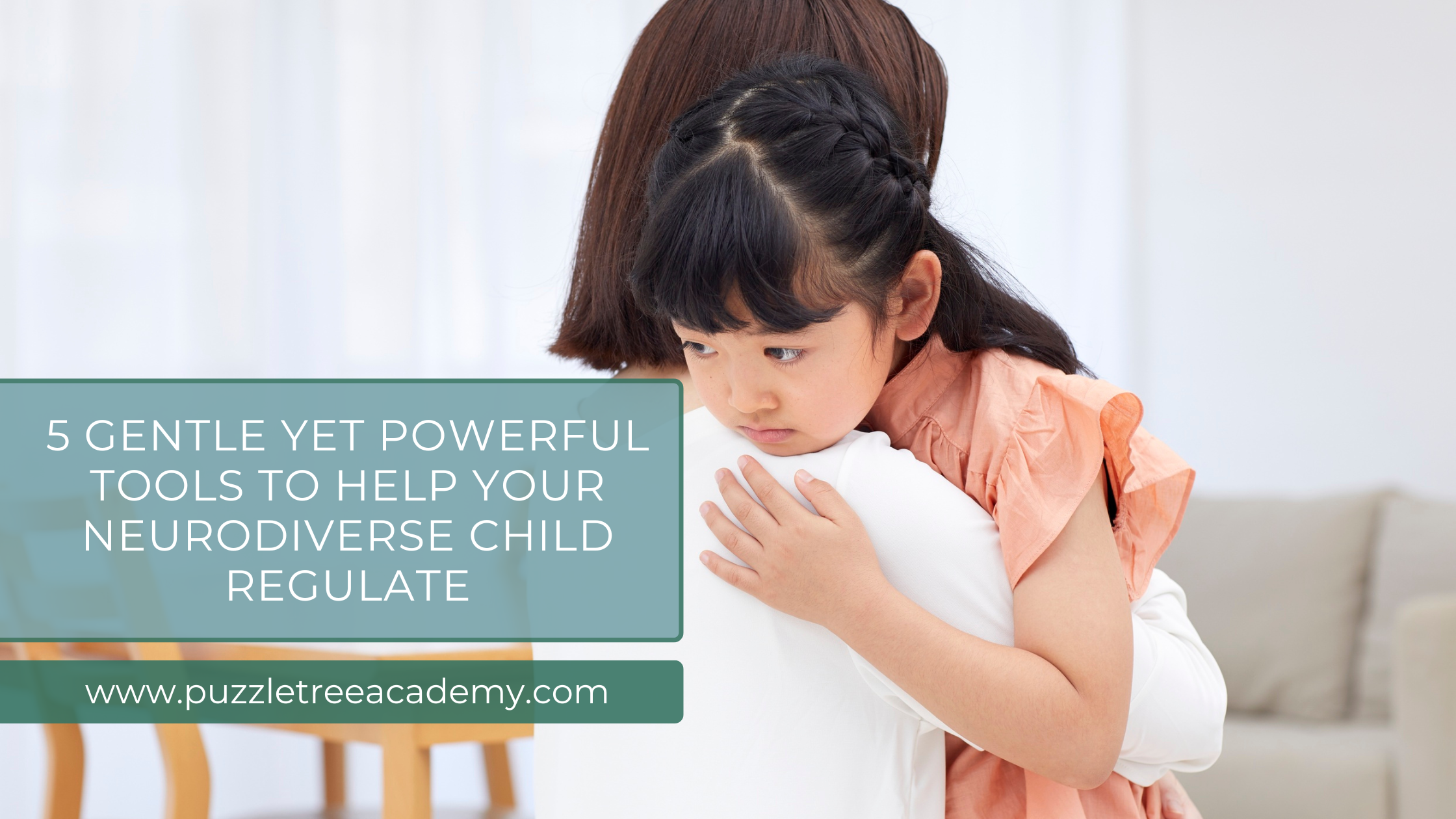
The First Five – Gentle Yet Powerful Tools to Help Your Neurodiverse Child Regulate
If you’ve ever felt like you’re drowning in your child’s emotions…
...or like everyone’s watching but no one truly understands—this is for you.
This blog is not just a set of tools. It is a shift in mindset—from frustration to understanding, from reacting to anchoring, from exhaustion to possibility.
Let us take a breath together and explore the quiet power of co-regulation. Not as a theory, but as a lifeline.
What if your child’s most difficult moments were actually invitations? Not to fix them, but to anchor them.
Would you show up differently if you knew that your calm is their medicine?
So many of the behaviours we wrestle with—outbursts, shutdowns, refusal—are not signs of defiance. They’re messages from a nervous system in distress. And our response is the bridge.
Neurodiverse children (with Autism, ADHD, PDA, and other profiles) often live in a state of constant alert. Their brains and bodies are flooded with signals of danger, even when no visible threat is present. That means learning, connecting, or even trying can feel impossible.
So, if your child seems unreachable, it is not because they are not trying. And it is certainly not because you are failing.
They are not misbehaving. They are doing their best to stay afloat.
This is where our gentle, powerful work begins.
🌿 A Foundation for Rebalancing the Neurodiverse Child
If you’ve been part of the Puzzle Tree Academy community, you may already know our signature programme, Rebalanced Child with Neurodiversity, which introduces families to the 7 Essentials and 3 Fundamentals of a regulated and resilient child. These include nutrition, sleep, detoxification, movement, sensory input, and more.
But even with the "right" support in place, there are moments when nothing seems to work. That is often because:
Safety must come first.
When a child’s nervous system is overactivated, no amount of broccoli, essential oils, or fidget toys will get through.
The amygdala is like a smoke detector for the brain. When it is constantly sounding the alarm, even kind gestures can feel like demands.
So before we intervene, we reconnect.
Before we add more, we soften.
Before anything else, we regulate.
Tool 1: Co-Regulation & The Regulated Parent
The nervous system is contagious.
Your calm is more powerful than any parenting script.
If your heart races, if your breath shortens when your child melts down—you are not doing it wrong. You are feeling it with them. That is your empathy in motion.
But here is the shift: instead of being swept in, we anchor.
✅ What You Can Do:
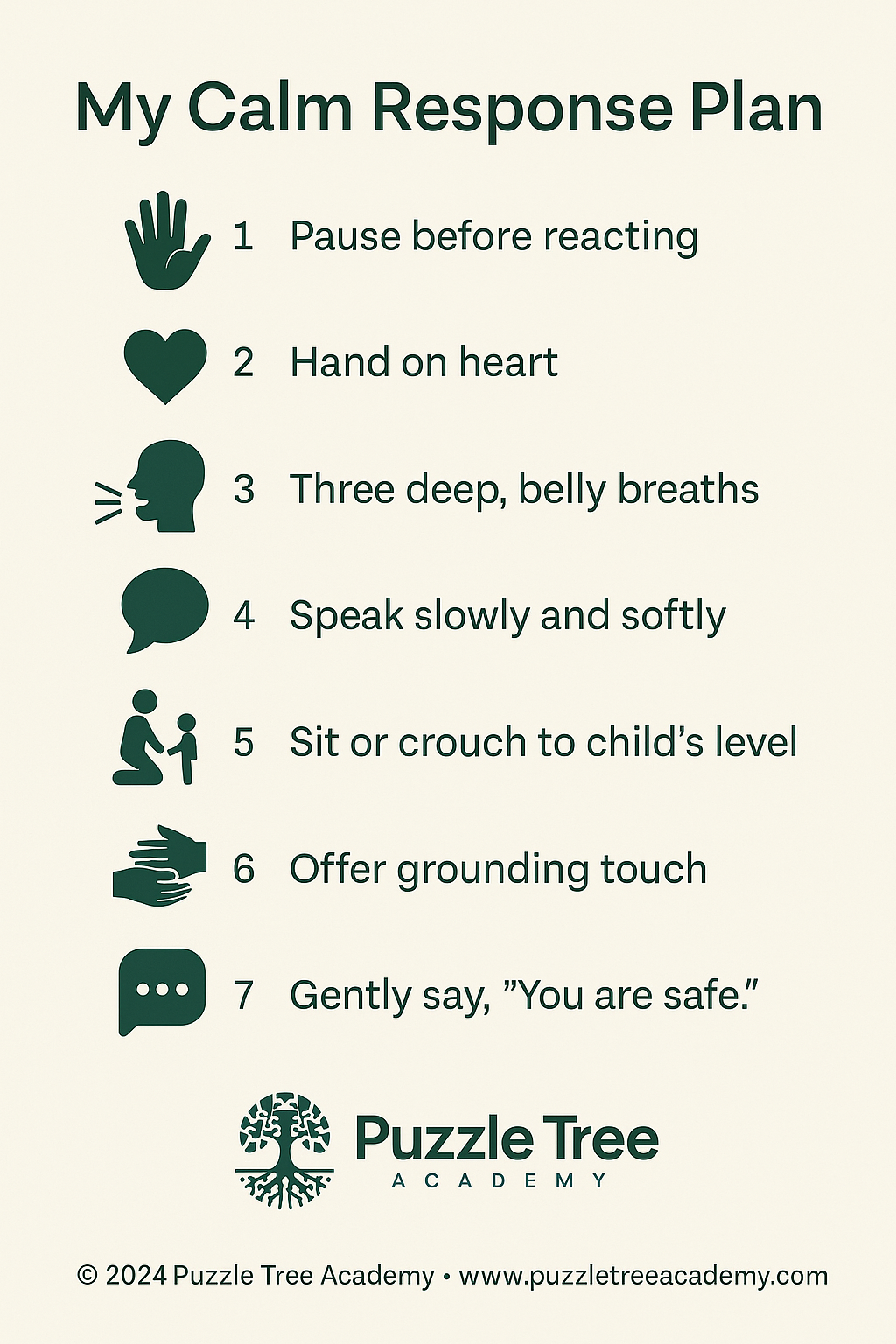
Place your hand on your heart. Take three deep, belly breaths.
Check your body: Is your jaw clenched? Shoulders high? Soften with your out-breath.
Speak slowly, or do not speak at all. Try humming or simply being there.
Lower yourself to their level. Be eye-to-eye or sit beside them.
If touch is welcome, rest your hand on your heart or theirs.
Say calmly, "You are safe," or "I’m right here with you."
If you begin to feel overwhelmed, name it: "I’m noticing I’m getting overwhelmed too. I’m going to breathe with you."
💡 Why This Helps:
When your nervous system settles, theirs can follow. It is not about perfection—it is about presence.
✨ Mini affirmation: “My calm is not a luxury. It is a gift I give to both of us.”
Tool 2: The Window of Tolerance
Your child is not giving you a hard time. They are having a hard time.
The Window of Tolerance is the zone where we feel safe, connected, and capable. When your child moves outside of this window, they flip into fight, flight, freeze or flop.
✅ What You Can Do:
Learn your child’s cues: Are they breathing quickly? Clenching fists? Zoning out?
Gently narrate without judgment: "It looks like this is too much right now."
Use rhythm: sway, rock, pat your hand on the floor.
Offer visuals or sensory items to support regulation.
Create a "Reset Spot"—a cosy space with soft lights or calming textures.
Provide choices, not commands: "Do you want to cuddle or stomp it out?"
💡 Why This Helps:
Regulation tools work with the body, not against it.
✨ Mini affirmation: “I honour what my child’s body is telling me.”
Tool 3: Low Demand, Low Expectation Parenting
This is not about lowering standards. It is about honouring the reality of the moment.
Demand-avoidant and anxious children thrive when pressure is removed and choice is restored.
✅ What You Can Do:
Ask yourself: "Is this essential right now, or can it wait?"
Let go of praise charts or pressure when your child is dysregulated.
Use declarative language: "I’m putting your toothbrush on the sink for later."
Offer autonomy: "Pyjamas or clothes? Want to get dressed after breakfast?"
Celebrate effort: "You stayed with me while it was hard. That’s brave."
💡 Why This Helps:
Low-demand parenting builds trust and prevents power battles.
✨ Mini affirmation: “I choose presence over pressure.”
Tool 4: Sensory Regulation Through Movement & Play
Movement is not a distraction. It is regulation. It helps the body release tension and return to balance.
✅ What You Can Do:
Add movement every 30–60 minutes: jumping, swinging, crawling, dancing.
Offer "heavy work": carrying, pushing, wall presses.
Invite water play, playdough, or sensory bins.
Let them fidget or wiggle during learning. Use yoga balls or wobble cushions.
Use music to shift energy—slow sways or stomping beats.
💡 Why This Helps:
Sensory input resets the nervous system and supports brain-body connection.
✨ Mini affirmation: “Movement is medicine, not mischief.”
Tool 5: Connection-Based and Identity-Safe Play
Play is not a reward. It is a relationship builder.
Children express emotions, process experiences, and build confidence through play—especially when it honours who they are.
✅ What You Can Do:
Join their world. Let them lead.
Repeat the same game for the 10th time with genuine curiosity.
Use pretend play to explore feelings or future plans.
Celebrate their passions in play—dinosaurs, trains, fairies, whatever lights them up.
Keep it short but rich—5–10 minutes of full attention goes far.
💡 Why This Helps:
Play builds trust, safety, and joy. It helps your child feel seen and valued.
✨ Mini affirmation: “Connection creates change.”
🌼 Before You Begin
Do not try everything at once. Choose one small thing.
Practice it gently. Let it grow over time.
Practise when things are calm.
Let it be imperfect.
Celebrate small shifts.
📌 You might even set a weekly reminder: “Try one tool today.”
📥 Free Download: Your Calm Plan Visual Reminder
Feel free to Download it. Print it. Pin it. Practise it.
🌳 Final Thoughts: You Are the Tool That Matters Most
This is not about having all the answers.
It is about becoming the safe space your child needs most.
These five tools are not just strategies. They are bridges to connection, regulation, and possibility.
✨ Want more tools like this?
Join our Neurodiverse Parenting Support Group
Comment below: What tool are you starting with today?
You are not alone on this journey. And this… is just the beginning. 🌱


I'm Olga Pavlova,
the founder of Puzzle Tree Academy
We provide holistic, implementable, creative, sustainable, and positive solutions that'll help you and your lovely family grow and flourish with neurodiversity.
Our Classes


We Understand You
At Puzzle Tree Academy, all our trainers, educators, and therapists have personal and/or long-term professional experience in Neurodiversity.
The majority of our trainers have children with neurodiversity or are Neurodiverse themselves. So, from deep practical experience, we know all the difficulties you may face on the way to sustainable progression.


If You're the Parent
who wakes up daily, yearning for just one more hour's sleep
who feels like they've tried every conceivable 'fix' under the sun
who understands that neurodiversity doesn't need fixing but that difficulties associated with it can be positively addressed
who wants to see their child FLOURISH into an incredibly fulfilled and independent individual with the RIGHT guidance, support and resources
This is the right place for you because we walk a similar path to yours
Explore Our Services
How We Can Help
Book your free Orientation Meeting and let’s talk about your child's needs to figure out what to do next.
Assessments
Help your child grow with our detailed assessments: from identifying specific developmental needs to restoring biochemical balance we give you a personal plan for visible results.
Courses
Transform your neurodiversity parenting journey with our expert-led NeuroNurturing courses, tailored to empower you with practical tools and insights for lasting change.
Community
Join a nurturing space for understanding, guidance, and solidarity, with a network of like-minded parents and experts dedicated to empowering neurodiverse families.
Coaching
Whether you're a parent navigating the complexities of neurodiversity, a family seeking balance and understanding, or an individual in transition, our expert coaches are here to empower you.
How We Can Help
Take an assessment
Help your child grow with our detailed assessments: from identifying specific developmental needs to restoring biochemical balance we give you a personal plan for visible results.
Enroll in a Course
Transform your neurodiversity parenting journey with our expert-led NeuroNurturing courses, tailored to empower you with practical tools and insights for lasting change.
Join the community
Join a nurturing space for understanding, guidance, and solidarity, with a network of like-minded parents and experts dedicated to empowering neurodiverse families.
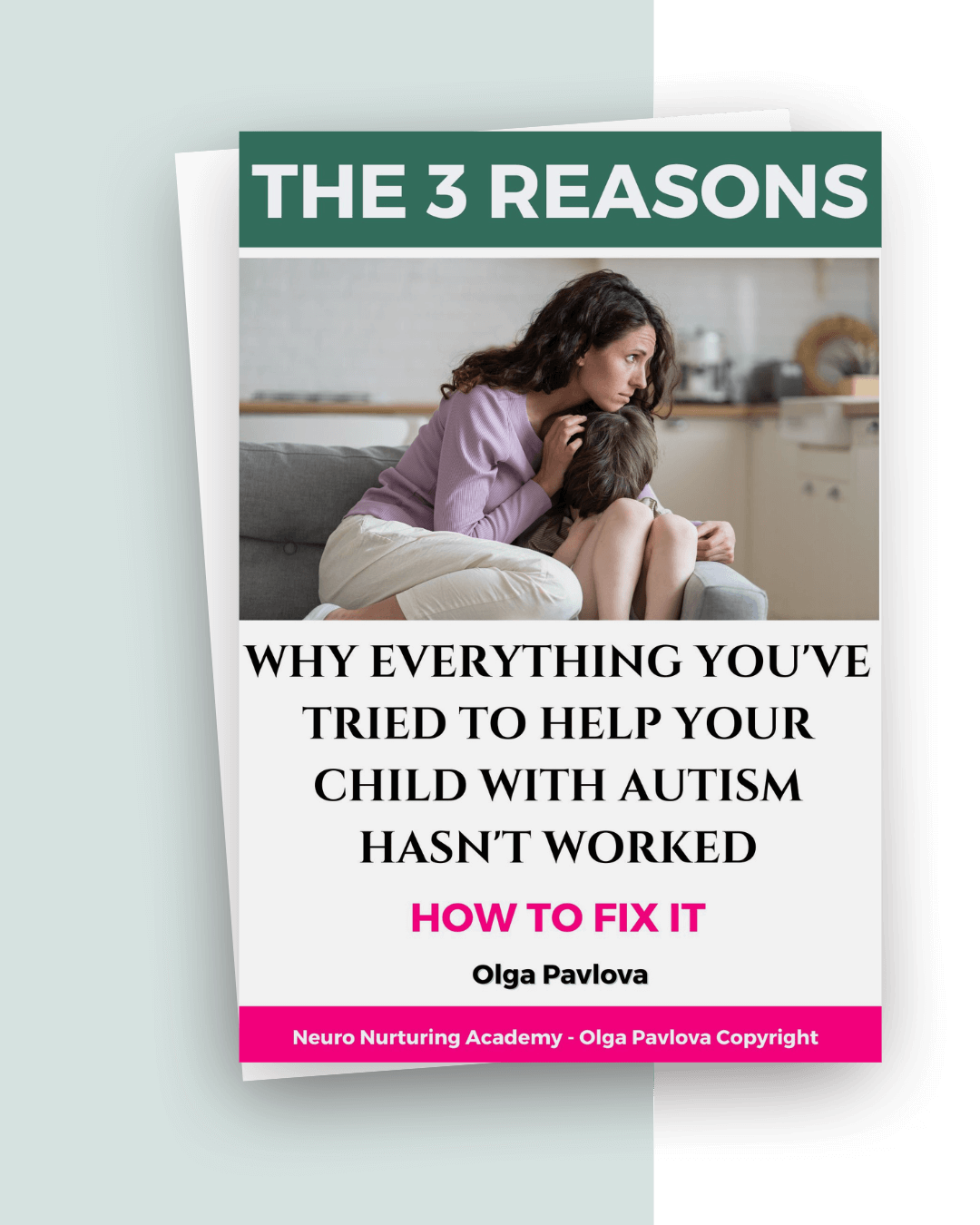
Free Guide
The 3 Reasons Why Everything You've Tried to Help Your Child With Autism Hasn't Worked and How to Fix it
Download our experience-based guide.

Free virtual meet-up
Imagine Finding a Real Support Network and Solutions That Work!
Join our free monthly virtual meet-ups for parents of children with Autism, ADHD or other Neurodevelopmental conditions to connect with other parents and gain expert advice.

© Puzzle Tree Academy - Terms of Service - Privacy Policy - Built on Taft Systems - Design by ElenaKoz